- December 23, 2025
- 2025 , Circulars
- Comments : 0
Revised recommendations for entering enclosed spaces aboard ships MSC.581(110)
C25070 | 23 December 2025
Notice to: Ship Owners/ Managers/ Operators/ Surveyors/ Auditors
At its 110th session, the IMO Maritime Safety Committee adopted Resolution MSC.581(110), which provides revised recommendations for entering enclosed spaces aboard ships. These revised recommendations supersede and revoke Resolution A.1050(27) and enter into effect on 3 December 2025.
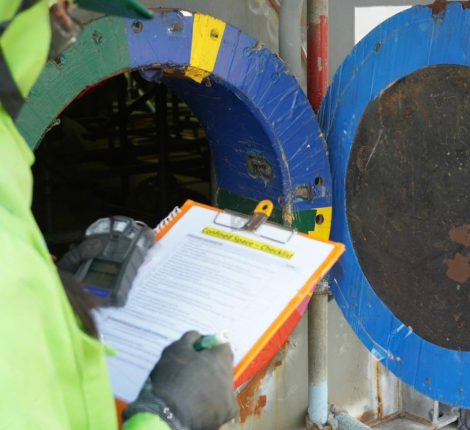
The recommendations emphasize the use of portable gas detection equipment, including CO₂ measurement, and the maintenance of a formal register of enclosed spaces onboard.
These measures aim to enhance crew safety by identifying potential hazards, such as oxygen deficiency or toxic/asphyxiant gases, prior to entry into confined spaces.
Points to Note
Companies and vessels should ensure:
Portable Gas Detection Equipment
- Portable gas detectors are available and capable of measuring CO₂ as well as other relevant gases, properly calibrated, and maintained.
- Crew and Surveyors entering enclosed spaces are provided with personal, portable gas detectors capable of continuously monitoring:
- Oxygen (O₂)
- Carbon dioxide (CO₂)
- Flammable gases or vapours (LEL/LFL)
- Toxic gases (including CO)
- Any other gases identified in the risk assessment
- Verify existing detector capability; replace or supplement as needed.
- Update SMS training, familiarization, maintenance, and calibration records.
Enclosed Space Entry Criteria
- Single-person entry is not permitted.
- Entry doors/access hatches must be secured unless the space has been risk-assessed, ventilated, atmospherically tested, and declared safe.
- Entry is only allowed when stable atmospheric readings confirm that all parameters are within acceptable limits:
- O₂ ≥ 20.9% by volume
- CO₂ < 0.5% by volume (5,000 ppm)
- Flammable gases/vapours < 1% of LFL
- Toxic gases/vapours < 50% of applicable OEL
- Proper illumination, communication, PPE, attendant, rescue/resuscitation equipment, and entry permit issuance.
Enclosed Space Register
- Establish and maintain the Enclosed Space Register onboard and ashore, ensuring it is regularly reviewed and updated based on cargo operations, structural changes, or hazard re-assessment.
- Include all connected and adjacent spaces in the register and risk assessments.
- Ensure these spaces are tested and ventilated as part of entry preparation.
- Assume connected and adjacent spaces are hazardous until proven otherwise.
Emergency Response and Risk Assessment
- Develop/update ship-specific Enclosed Space Emergency Response Plans, detailing rescue roles, equipment, communication, and procedures.
- Conduct regular rescue drills and ensure all rescue equipment is functional and accessible.
- Strengthen SMS risk assessment procedures, documenting hazards, residual risks, and mitigations before permitting entry.
- Distribute cargo hazard information and incorporate it into risk assessments.
Entry Permit, Signage, and Equipment
- Enclosed Space Entry Permits must have a maximum validity of 8 hours.
- Emergency Escape Breathing Devices (EEBDs) are only for escape, not entry.
- Access points should be clearly marked as SAFE or UNSAFE for entry, and signage updated as space status changes.
Act now
Ship Owners / Managers / Operators/ Surveyors/ Auditors should review onboard equipment and procedures to ensure compliance with the revised recommendations for enclosed space entry. Dromon auditors will verify compliance during the first company-level or shipboard audit.
For further guidance, companies may refer to the IMO Resolution MSC.581(110).