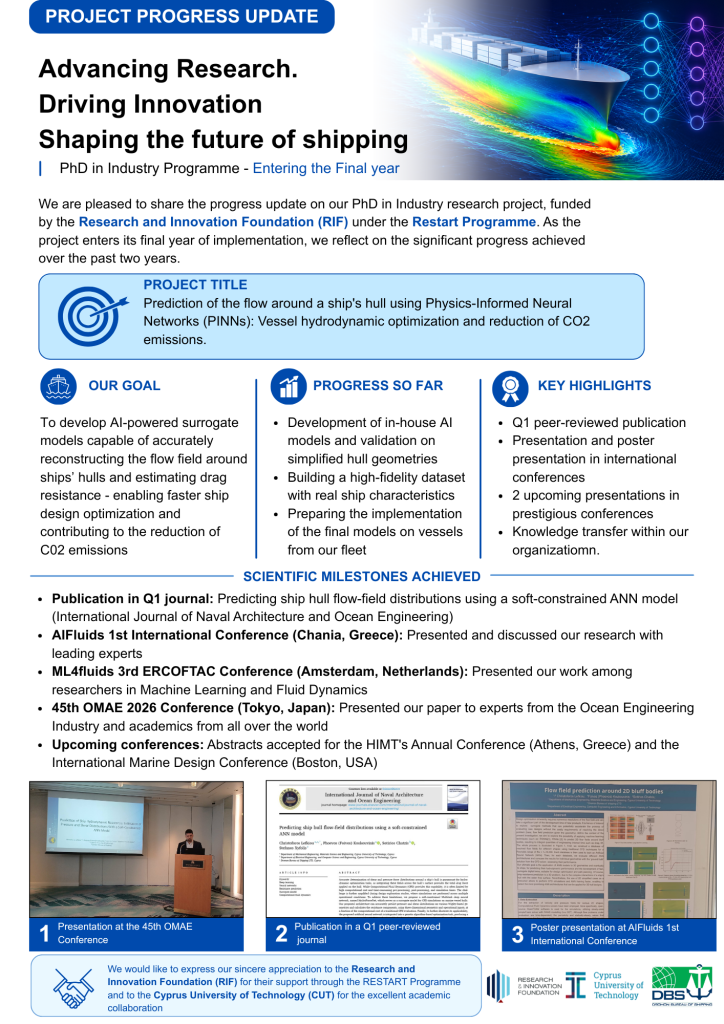
Project Progress Update – Entering the Final Year of our PhD in Industry Project
We are pleased to share a progress update on our PhD in Industry research project, funded by the Research and Innovation Foundation under the RESTART Programme.
As the project enters its final year of implementation, we are pleased to reflect on the progress achieved so far and highlight some of the key scientific milestones accomplished during the first two years of the project.
Project Objective:
The project, entitled “Prediction of the flow around a ship’s hull using Physics-Informed Neural Networks (PINNs): Vessel hydrodynamic optimization and reduction of CO₂ emissions”, aims to reconstruct the flow field around ship hull geometries using Machine Learning (ML) surrogate models, enabling fast and accurate estimation of hydrodynamic resistance.
Traditional drag prediction methods often require significant computational resources, specialized software and lengthy simulation times. By leveraging Artificial Intelligence and Physics-Informed Neural Networks (PINNs), this research seeks to provide efficient predictive models that can support ship design optimization and contribute to reducing CO₂ emissions within the maritime sector.
Progress Achieved:
During the first phase of the project, significant progress has been made towards the project’s objectives.
Among the key achievements are:
- Development of in-house Artificial Neural Network (ANN) architectures.
- Successful validation of the developed models on simplified Wigley-based hull geometries, producing highly encouraging results.
- Ongoing development of a more advanced dataset incorporating realistic ship hull characteristics, including bulbous bows, parallel mid-bodies, transom sterns, flat of bottom and flat of side geometries, which will support the next phase of model development and validation.
- Preparation for the implementation of the final Machine Learning models on vessels from the Dromon Bureau of Shipping fleet.
Scientific Dissemination & Research Activities
The project has already generated several important scientific outcomes:
Peer-reviewed Publication
The research has been published in the International Journal of Naval Architecture and Ocean Engineering (Elsevier – Q1 Journal).
Article:
“Predicting ship hull flow-field distributions using a soft-constrained ANN model”
https://doi.org/10.1016/j.ijnaoe.2025.100712
Conference Presentations
Our work has been presented at:
- 4th Doctoral Colloquium, (Limassol, Cyprus)
- AIFluids 1st International Conference, (Chania, Greece)
- 3rd ERCOFTAC Machine Learning for Fluid Dynamics Workshop, (Amsterdam, Netherlands)
- 5th Doctoral Colloquium, (Paphos, Cyprus)
- 45th International Ocean, Offshore and Arctic Engineering Conference (Tokyo, Japan)
These events provided valuable opportunities to discuss our research with leading experts and receive constructive feedback for the project’s next stages.
In addition, abstracts have been accepted for presentation at:
- Hellenic Institute of Marine Technology (H.I.M.T) Annual Conference, (Athens, Greece)
- International Marine Design Conference (IMDC), (Boston, USA)
Knowledge Transfer:
As part of the project’s dissemination activities, a dedicated presentation was delivered to Dromon Bureau of Shipping personnel, demonstrating the application of Computational Fluid Dynamics (CFD) simulations and Artificial Intelligence within the maritime industry. This initiative highlights the importance of strengthening collaboration between academia and industry while promoting the practical adoption of advanced research outcomes.
Looking Ahead:
During the final phase of the project, our efforts will focus on extending the developed Machine Learning framework to realistic ship hull geometries and ultimately deploying the validated models on vessels from our fleet.
We remain committed to delivering research that combines scientific excellence with practical impact for the maritime industry.
We would like to express our sincere appreciation to the Research and Innovation Foundation (RIF) for its continued support through the RESTART Programme, as well as to the Cyprus University of Technology for the valuable academic collaboration that makes this research possible.
We look forward to sharing further developments as the project progresses towards its successful completion.
#Research #Innovation #PhDinIndustry #ArtificialIntelligence #MachineLearning #PhysicsInformedNeuralNetworks #ComputationalFluidDynamics #Maritime #NavalArchitecture #Hydrodynamics #Sustainability #ResearchAndInnovation #DromonBureauOfShipping